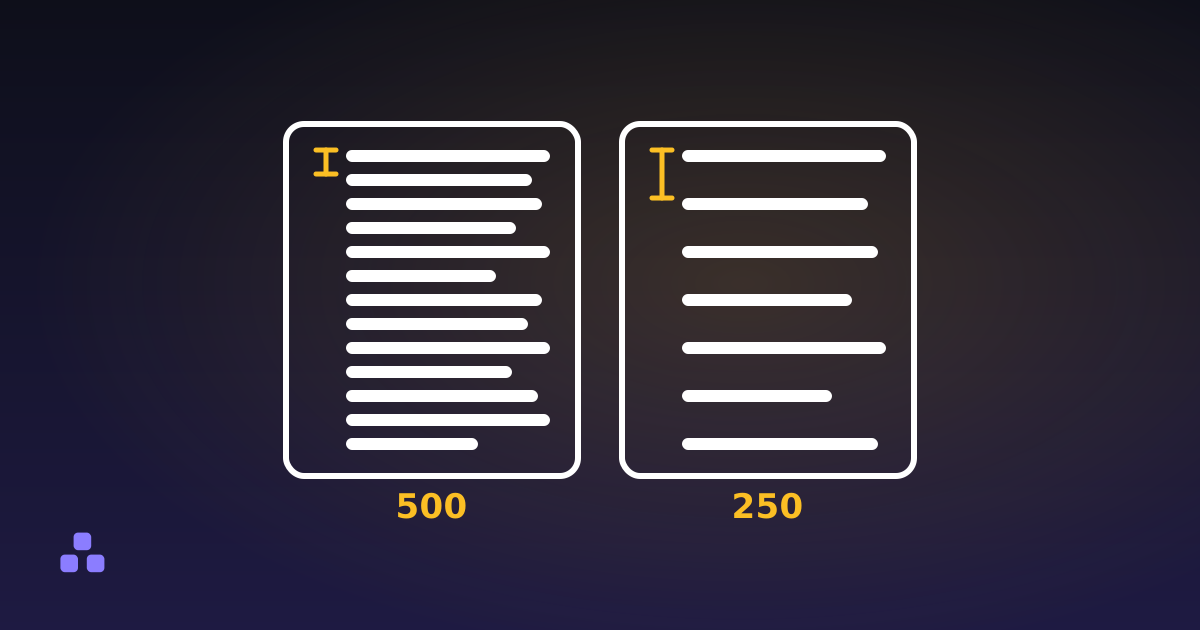
A page holds about 500 words single-spaced and about 250 double-spaced, at 12 point type with one-inch margins. Those are the working figures, and a real document lands under them rather than over: every paragraph ends on a partly empty line, and every heading costs its own line plus the space around it. When the number has to be right — a submission limit, a rate paid per page, a brief you have to hit — count the words and do the division yourself, because the page count is decided by the layout and the word count is not.
That is the whole reason this question has no single answer. A word count belongs to the text. A page count belongs to the text plus the typeface, the type size, the line spacing, the margins, the paper and the line-breaking of whatever program is showing it. Switch an essay from Courier to Times New Roman and it loses a page and a half without a word being edited.
Where the 250-word page comes from
It is not a survey result. It is typewriter arithmetic, and for the machine it describes it is exact.
Courier is monospaced: every character, from the i to the m, takes the same width. At 12 point that width is exactly a tenth of an inch, so a 6.5-inch line — Letter paper with one-inch margins — holds exactly 65 characters. Running English prose averages around five letters a word, plus the space after it, so call it six character widths per word. That is a shade under 11 words to a line.
Vertically, a typewriter advanced six lines to the inch, so double spacing gave three: 27 lines in nine inches of page, and about 25 once a header line and a short last line are taken out. Twenty-five lines at ten words is 250. That is why a publisher who asks for a manuscript page still means 250 words, and why rates quoted per page are written against it.
What broke the figure was proportional type. Times New Roman fits far more characters into the same 6.5 inches than Courier does, because its i is narrow and its space is narrow. The page did not change. The letters did.
How many lines fit on a page
Start with the paper. Letter is 8.5 × 11 inches. A4 is 210 × 297 millimetres, which works out to 8.27 × 11.69 inches — narrower and taller. Take an inch off each edge and the text block is 6.5 × 9 inches on Letter, 6.27 × 9.69 inches on A4.
Then the line spacing. A point is 1/72 of an inch, so nine inches of text height is 648 points. What a word processor calls single spacing is not the type size but the font’s own line height, which is a little larger, because the font reserves room above the capitals and below the descenders: about 14 points for a 12 point text face. Double spacing is twice that.
| Paper, one-inch margins | Lines single-spaced | Lines double-spaced |
|---|---|---|
| Letter, 8.5 × 11 in | about 46 | about 23 |
| A4, 210 × 297 mm | about 49 | about 24 |
Two things quietly cost you lines. Word has not defaulted to single spacing for years: the current body style sets the spacing a hair above single and adds 8 points after every paragraph, so a document nobody reformatted is already looser than the arithmetic assumes. And a heading is worth three or four lines of body text once the air above and below it is counted.
How many words fit on a line
This is where typefaces part company. Courier is the one exact case, at ten characters to the inch. A proportional face has an average character width instead, and in running prose 12 point Times New Roman averages a little under 5.5 points a character, counting its narrow space. Arial is wider. Divide the measure by that average, then divide by six character widths per word.
| Typeface, 12 pt on Letter | Characters a line | Words single-spaced | Words double-spaced |
|---|---|---|---|
| Courier New | 65, exactly | about 500 | about 250 |
| Times New Roman | 85 to 90 | about 650 | about 330 |
| Arial | 75 to 80 | about 600 | about 300 |
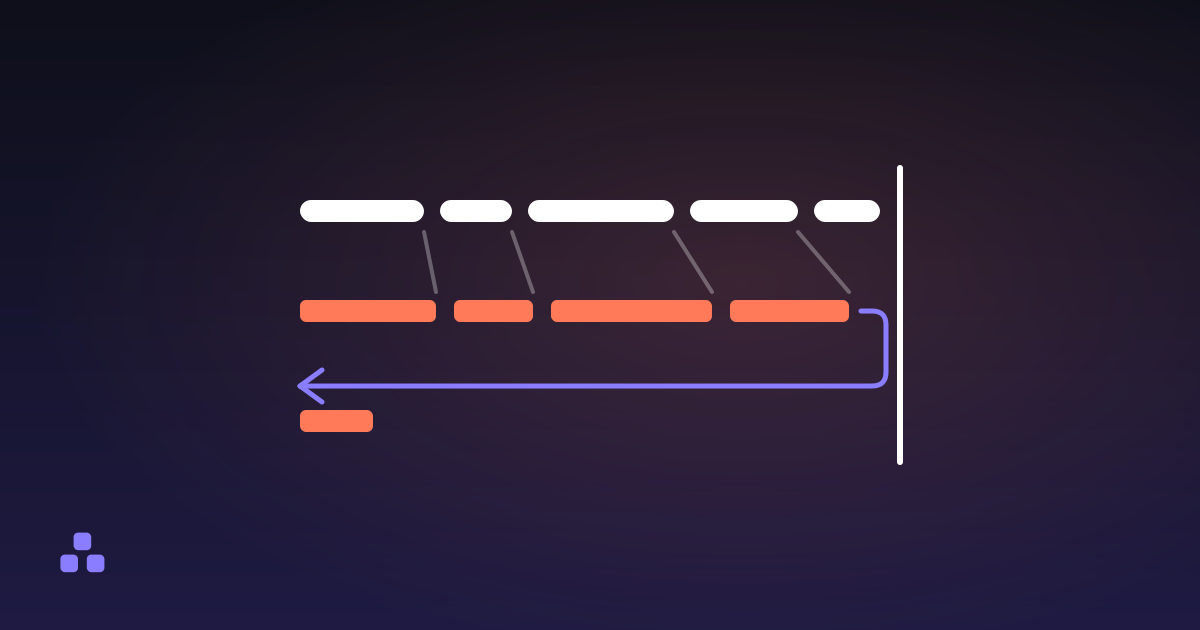
Read those as ceilings, because they assume a page of unbroken prose and nobody writes one. A paragraph ends where it ends, leaving the rest of that line empty; a blank line between paragraphs is a line; a subheading is several. Deflate the arithmetic for those and a real page of 12 point Times New Roman lands near the 500 that the rule of thumb promised in the first place. The rule of thumb is not wrong so much as it is Courier’s exact figure doing duty as everyone else’s rough one.
Does A4 hold more than Letter?
Slightly, and in the direction most people guess wrong. A4 is narrower than Letter but a good deal taller, and the height wins: with the same one-inch margins the text block is 60.8 square inches against Letter’s 58.5, about four per cent more. Call it one extra line in every twenty-five.
Four per cent will not rescue a word count, and it is more than enough to move every page break in a long document — which is how a report that paginated neatly for a colleague comes back to you with one orphaned line on a final page. If the document arrived as a PDF, the sheet size is recorded in the file itself, in points: 612 × 792 for Letter, 595 × 842 for A4. Reading the page geometry lists it page by page and marks the ones that do not match the rest, which is usually how you discover that page 14 came from somewhere else.
What counts as a word, anyway?
Counting rules differ between programs, so two honest counts of the same text disagree by a few. The counter on this site splits on whitespace: a word is a run of non-whitespace between spaces, tabs or line breaks. So state-of-the-art is one word, e.g. is one, and 1,250 is one. Word behaves much the same way, which is why the two usually land within a handful of each other on ordinary prose and diverge on numbers with units, on dashes with no spaces around them, and on text pasted out of a PDF where the line breaks came along as characters.
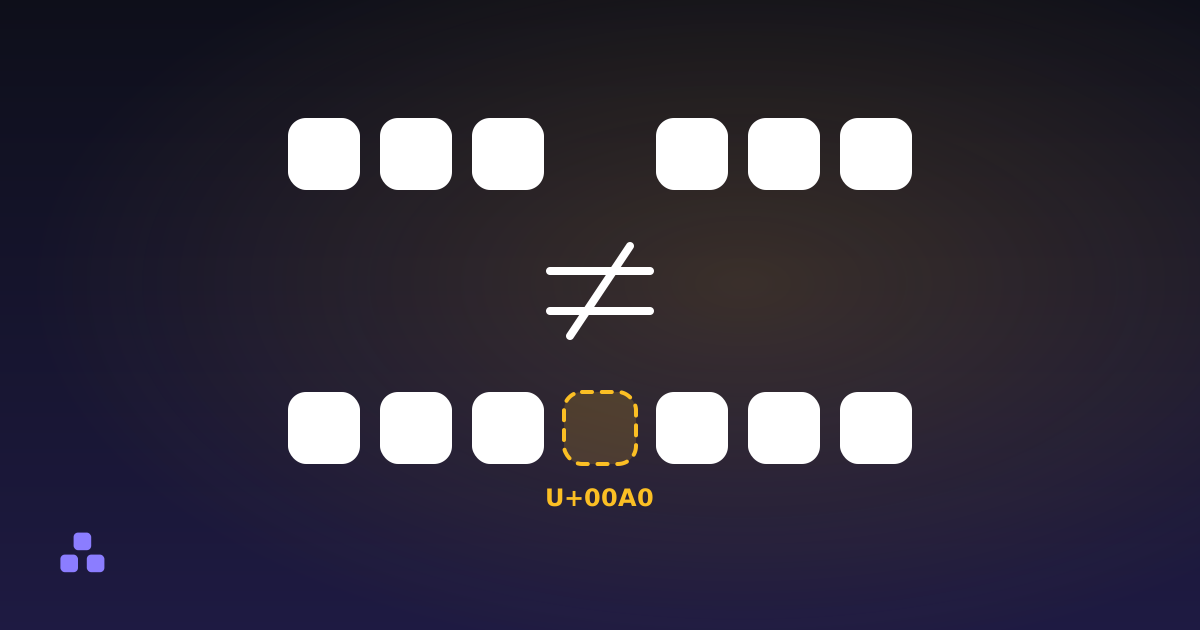
Pasted text carries other passengers too. Non-breaking spaces, soft hyphens and zero-width joiners survive a copy and change the character count without changing anything you can see, and a few of them will change the word count as well. The characters that survive a paste is the list of what to look for, and cleaning them out before you measure is the difference between a count and a guess.
If a limit is being enforced, one more question matters more than the counting rule: what is inside the limit. References, footnotes, tables, captions and headings are counted by some briefs and excluded by others, and the gap between the two readings is easily ten per cent of a long essay. Ask, and then measure in whatever software the person enforcing it will use.
Why a word count survives reformatting and a page count does not
A word count is a property of the text, so it travels. A page count is a property of a rendering, so it expires the moment anything about the rendering changes — and on a phone, where the text reflows to the width of the screen, it never existed at all. That is why submission limits, journal guidelines and translation rates are all quoted in words: it is the one figure that means the same thing on both machines.
A Word file makes this concrete in a way that surprises people. A .docx has no pages in it. It stores paragraphs, styles and a page size, and the pagination is worked out again every time something opens the file, which is why the count shifts between two computers with different fonts installed. Pages only become fixed when the document is converted to a PDF, and whatever the pagination looks like at that moment is what everyone downstream will see.
For a screen there is a more useful unit than either. Reading time is a word count divided by a rate: the counter here uses 238 words a minute, a median for adults reading non-fiction on screen. It is an estimate, and dense technical prose runs slower than that, but it answers the question a reader actually has better than a page count does.
How to hit a target that is given in pages
Convert it, write to the number, and format last.
- Convert with 250 or 500, whichever spacing the brief asks for. Three pages double-spaced is 750 words; ten pages single-spaced is 5,000. Round targets are a hint that nobody will be measuring the page itself.
- Write to the word count. Writing to the bottom of a page means rewriting whenever the format changes, and it invites the two worst sentences in any draft — the one added to fill a line and the one cut to save one.
- Apply the required format before you measure anything. Typeface, size, spacing, margins, in that order. Then look at where the last page lands.
- If it comes out short, do not pad the layout. Wider margins, a bigger face and a hair more leading are the first three things anyone marking a stack of documents notices, because they have seen all three.
Designers have the same problem from the other end: they need to know how a block of text will behave in a space before the words exist, which is what placeholder text is for. Either way the measurement comes first and the layout second.
The arithmetic above gives you an estimate. The only thing that settles an argument is a count, and the word and character counter here does it as you type or paste: words, characters with and without spaces, sentences, paragraphs, and the reading time that follows from them. Nothing is uploaded and nothing is saved, so a draft you paste in is gone when the tab closes. What it will not do is paginate — it counts the text, and the page count stays whatever your word processor decides.
If the target you were handed is in pages because someone is designing around your words rather than marking them, why designers still reach for lorem ipsum is the same question from the other side: how much text a space can hold, answered before the real copy shows up.
Frequently asked questions
How many words are on a double-spaced page?
About 250 at 12 point with one-inch margins, which comes from 25 lines of roughly 10 words. A proportional typeface such as Times New Roman fits more on each line, so the same page can carry 300 to 330 words. Expect the real figure to sit below the arithmetic, because paragraph endings and headings leave lines partly empty.
How many words fit on a single-spaced page?
About 500 at 12 point with one-inch margins, and up to roughly 650 in a narrow typeface like Times New Roman if the page is unbroken prose. Halving the line spacing roughly doubles the words per page, because the number of lines is what changes and the words per line stay the same.
How many pages is 1,000 words?
Four pages double-spaced or two pages single-spaced, at 12 point with one-inch margins. In a narrower typeface it can be nearer three double-spaced pages. If a submission has a page limit rather than a word limit, apply the required format first and then look at where the text ends.
Does a page of A4 hold more words than a page of Letter?
Yes, by about four per cent. A4 is narrower than US Letter but noticeably taller, and with equal margins the extra height more than cancels the lost width. It is not enough to matter for a word target, and it is more than enough to shift every page break in a long document.
Why does my page count differ from someone else’s for the same text?
Because a page count is produced by the layout, not by the text. A different typeface, type size, line spacing, margin width or paper size changes it, and so does a different program breaking lines its own way. The word count is identical in all of those cases, which is why limits are written in words.
Do all tools give the same word count?
Close, but not identical. Most count runs of characters between spaces, so hyphenated compounds and abbreviations count as one word each, while numbers with units and dashes without spaces are handled differently from one program to the next. If a limit is being enforced, take the final figure from the software the person enforcing it uses.
Last updated September 22, 2026