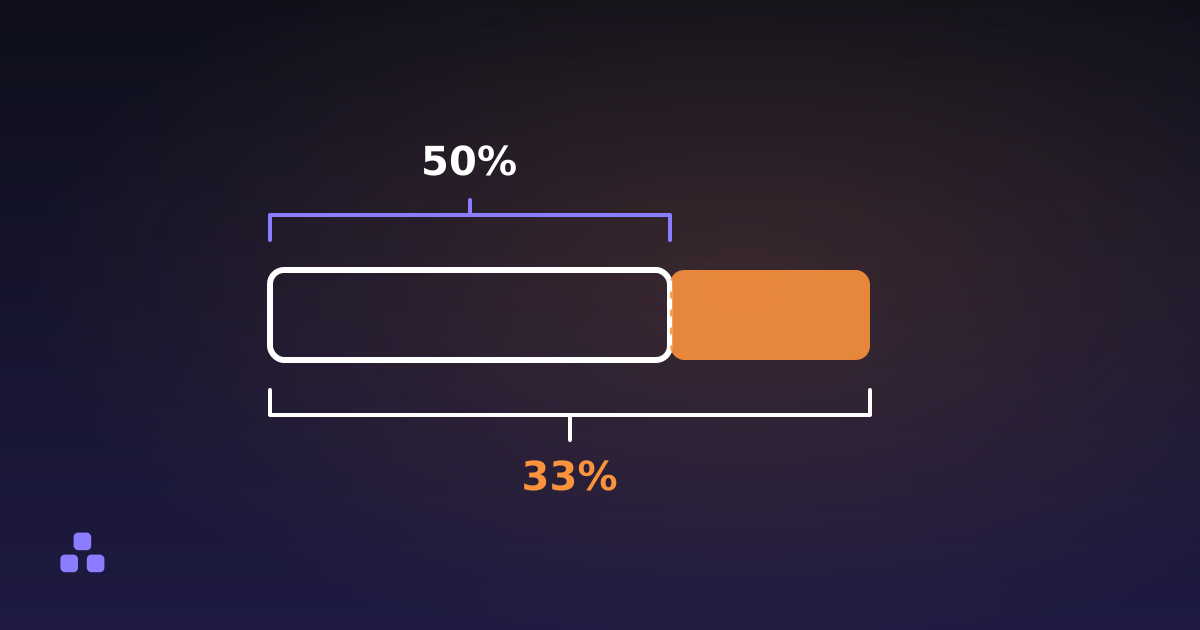
Markup and margin are the same profit measured against different things. Markup is profit divided by cost; margin is profit divided by price. Buy something for 60 and sell it for 90 and the profit is 30 either way, but 30 ÷ 60 is a 50% markup and 30 ÷ 90 is a 33.3% margin. The margin is always the smaller number, and mixing the two up is how a business ends up earning less than it planned.
What is the difference between markup and margin?
Only the base changes. Take the 60 item sold at 90:
- Cost: 60.
- Price: 90.
- Profit: 90 − 60 = 30.
- Markup: 30 ÷ 60 = 0.50, so 50% — how much you added on top of what it cost you.
- Margin: 30 ÷ 90 = 0.333, so 33.3% — how much of what the customer paid is yours to keep.
Neither is wrong. They answer different questions. Markup is natural when you start from a supplier invoice and decide what to add. Margin is natural when you look at a till total and ask what share of it is profit. Margin can never reach 100%, because cost is never zero. Markup has no ceiling at all: sell for three times what you paid and the markup is 200%.
This is the same trap that runs through percentages in general: the number means nothing until you know what it was divided by.
How do I convert markup to margin, and back?
Two short formulas, with the markup and the margin written as decimals (50% is 0.5):
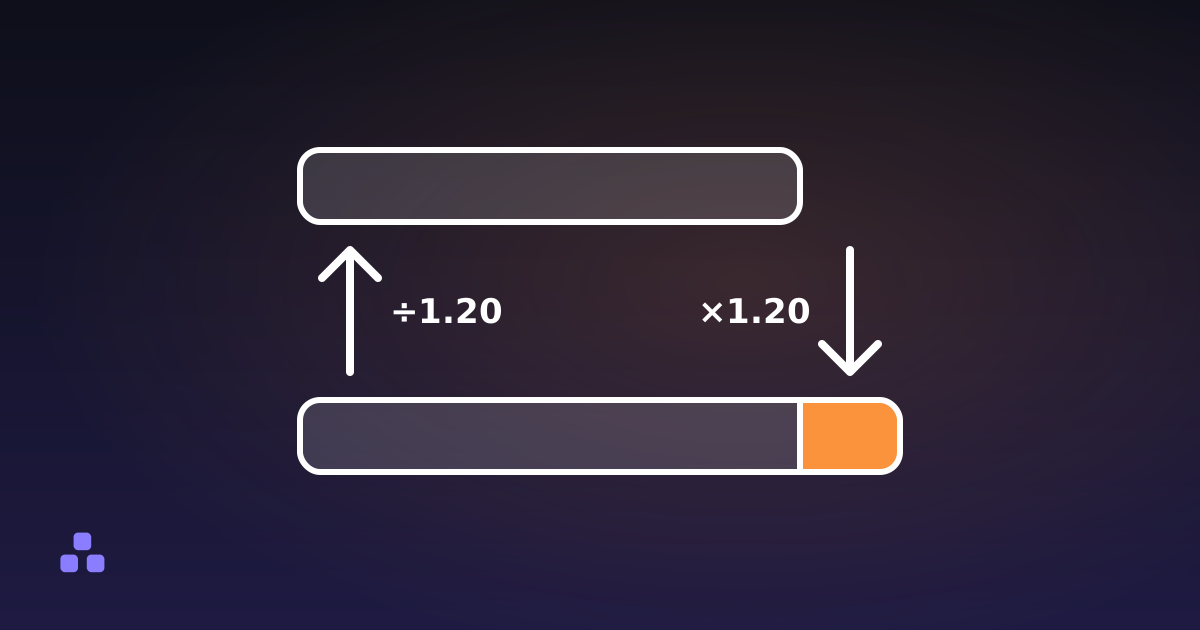
- Margin = markup ÷ (1 + markup). For 0.5: 0.5 ÷ 1.5 = 0.333.
- Markup = margin ÷ (1 − margin). For 0.333: 0.333 ÷ 0.667 = 0.5.
| Markup on cost | Margin on price |
|---|---|
| 10% | 9.1% |
| 25% | 20% |
| 50% | 33.3% |
| 100% | 50% |
| 200% | 66.7% |
Read it the other way for the margin you are aiming at: a 20% margin needs a 25% markup, 30% needs 42.9%, 40% needs 66.7%, and 50% needs 100%, which is simply doubling the cost. The gap is small at low percentages and grows quickly, which is why people get away with the confusion on thin-margin goods and get hurt on everything else.
You do not need a dedicated tool for either. In the percentage calculator, the "% change from X to Y" button with cost as X and price as Y gives the markup, and "X is what % of Y" with the profit as X and the price as Y gives the margin. Both show the division they used, so you can see which base each one took.
Why does adding the margin to the cost give the wrong price?
Because a margin is a share of the price, and you are about to compute the price. Say the item costs 60 and you want a 40% margin. The tempting move is 60 × 1.40 = 84. Check it: the profit is 24, and 24 ÷ 84 is a 28.6% margin, not 40%.
The correct step is to divide by what the cost must be a share of. If 40% of the price is profit, 60% of the price is cost, so the price is cost ÷ (1 − margin): 60 ÷ 0.60 = 100. Profit 40, margin 40%. As a markup that is 66.7% on cost, which is what the conversion table said it should be.
The error always lands in the same direction. Applying a target margin as if it were a markup under-prices the item, and the shortfall grows with the percentage. At a 50% target the mistake is not 50% versus 33%, it is selling at 90 when you needed 120.
Which discount cancels a markup?
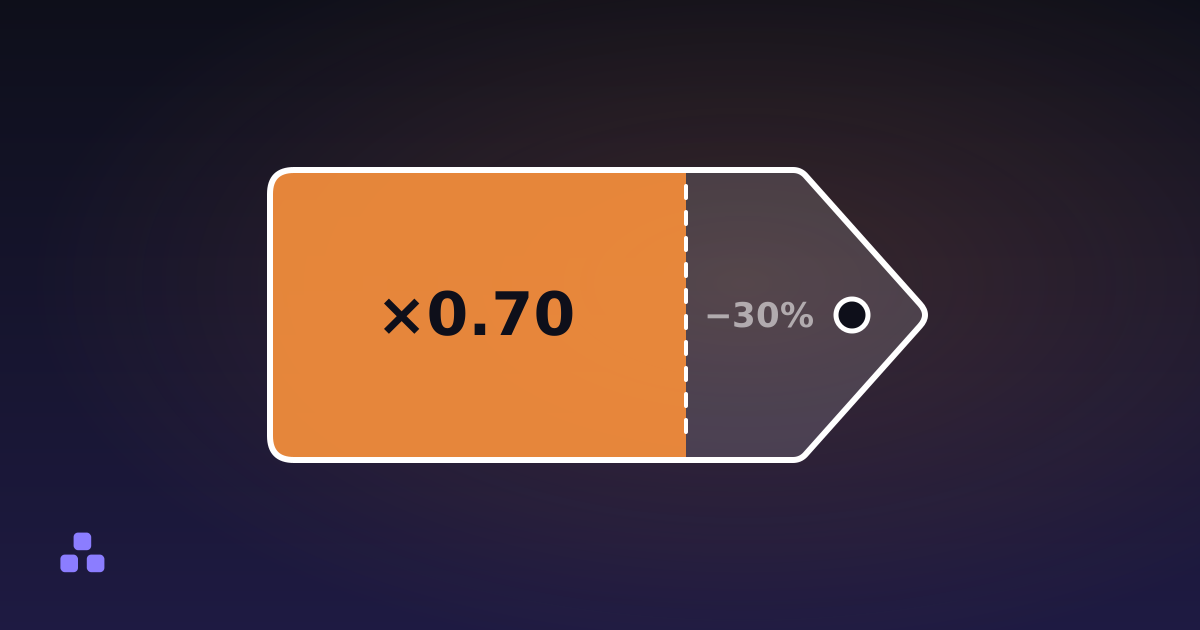
Not the same percentage. A 50% markup took 60 up to 90; a 50% discount takes 90 down to 45, which is below what you paid. The discount that gets you back to cost is the one that removes the profit as a share of the price, and that is the margin: 30 ÷ 90, or 33.3%.
This is the useful form of the rule: the discount that wipes out all profit is equal to the margin. A 25% markup breaks even at a 20% discount. A 100% markup, where you doubled the cost, breaks even at 50% off. If you know the margin, you know exactly how far a sale can go before it costs you money, and if you only know the markup, convert first.
What does a discount do to the margin?
More than the sign suggests, because the discount comes straight out of profit while cost stays where it was. Take a 100 item that cost 70: profit 30, margin 30%. Put it on 20% off and it sells for 80. The profit is now 10 and the margin 12.5%.
A 20% discount took away two thirds of the profit on every sale. To earn the same total, you now need to sell three of them where you used to sell one. Whether the discount pays for itself depends on whether it triples the volume, and that is a question worth asking before the sign goes up. To check the sale price itself, the discount calculator works it out, including a second discount stacked on the first. The order in which discounts combine is covered in how to calculate a discount.
Where do tax and other costs fit in?
Margin and markup, as used here, are measured on the price before tax and on the cost of the goods alone. A shelf price that includes 20% VAT is not your revenue: on a 90 net price the tag reads 108, and the 18 difference goes to the tax authority. Calculating a margin of (108 − 60) ÷ 108 = 44.4% would overstate it badly. Strip the tax first; how VAT works explains how.
The same logic applies to anything else you pay per sale. Card fees, shipping you absorb and returns all come out of the profit, so a "gross margin" computed from cost of goods is the top of a ladder and not what you keep. Different industries also define gross margin differently, in what counts as cost of goods, so when a figure comes from someone else, check what their cost included.
What the calculators here do not do
Neither tool has a markup or margin mode. The percentage calculator will do the two divisions above and the discount calculator will take a percentage off a price, but neither one knows what your cost is, and neither adds fees or tax to the picture. They do the arithmetic you give them, in your browser, with nothing sent anywhere. The thinking about which base is the right one is still yours.
If you have a cost and a margin in mind, the percentage calculator will check both divisions and show its working, so you can see whether a number was taken over the cost or over the price. It runs in the page and nothing you type leaves it.
The same slip, a percentage measured against the wrong number, runs through all of this, and how to calculate percentages without getting lost is the longer treatment of it.
Frequently asked questions
What is the difference between markup and margin?
Markup is profit divided by cost; margin is profit divided by selling price. Buying at 60 and selling at 90 makes 30 profit, which is a 50% markup but a 33.3% margin. The profit is identical, only the base differs, so margin is always the smaller percentage.
How do I convert a markup into a margin?
Divide the markup by one plus the markup, using decimals. A 50% markup is 0.5 ÷ 1.5 = 0.333, a 33.3% margin. To go back, divide the margin by one minus the margin: 0.333 ÷ 0.667 = 0.5, which is 50%.
How do I price something to get a 40% margin?
Divide the cost by one minus the margin. With a cost of 60, the price is 60 ÷ 0.60 = 100, which leaves 40 of profit, 40% of the price. Multiplying the cost by 1.40 instead gives 84 and a margin of only 28.6%, because the margin is a share of the price, not of the cost.
What discount makes me break even after a markup?
A discount equal to your margin, not your markup. A 50% markup is a 33.3% margin, so 33.3% off the selling price returns it exactly to cost. A 50% discount would sell it below cost. A 25% markup breaks even at 20% off, and a 100% markup at 50% off.
Is a 100% markup the same as a 100% margin?
No. A 100% markup doubles the cost, which is a 50% margin. A 100% margin would mean the item cost nothing, since profit would equal the whole price. Markup can exceed 100%; margin cannot.
Last updated October 2, 2026