To read a label from another country, do three conversions. Energy: 1 kcal is 4.184 kJ, so divide kilojoules by about 4.2 to get Calories. Basis: a per-100 g figure becomes a per-serving figure by multiplying by the serving weight and dividing by 100. Quantity: the packet total is the per-serving figure times the number of servings. The label is usually accurate. Most of the confusion comes from which of the three bases a number is on.
Is a kilojoule the same as a calorie?
No, but both measure energy, and the exchange rate is fixed. One food Calorie, written kcal, is 4.184 kJ (the figure behind the "Calorie, small" and "Food calorie" rows in the unit converter here). A label that says 1,590 kJ therefore says about 380 kcal. A mental version is to divide by four and add a little: 1,590 divided by 4 is about 400, and the true figure is 5% lower.
The "kcal" and "Calorie" in everyday speech are the same unit. A "small calorie", lower case and without the k, is a thousand times smaller and only appears in chemistry. Labels never use it.
One more thing explains why two conversions of the same food can disagree by a few kcal: label energy is calculated, not measured. In the EU, the regulation on food information lists the factors, in Annex XIV of Regulation 1169/2011: 17 kJ (4 kcal) per gram of carbohydrate or protein, 37 kJ (9 kcal) per gram of fat, 29 kJ (7 kcal) per gram of alcohol, 8 kJ (2 kcal) per gram of fibre. A label is those grams times those factors, and the factors are rounded. So 17 kJ is the stated figure and 4 kcal is the stated figure, even though 4 kcal is 16.7 kJ.
Per 100 g or per serving: which number do you use?
Use per 100 g to compare two products, and per serving to know what you will eat. Per 100 g is a fixed yardstick: the EU requires nutrient amounts per 100 g or per 100 ml (Article 32 of the same regulation), which is why labels bought in Europe always have that column. Per serving depends on a weight the manufacturer chose, so two cereals with the same energy per 100 g can show 110 and 180 kcal per serving purely because one picked 30 g and the other 45 g.
The US works the other way round. Its serving size is set by rule from the amount customarily eaten at one sitting (21 CFR 101.9), so the headline numbers are per serving, not per 100 g. If you are comparing a US label with a European one, you have to produce the per-100 g figure yourself: divide the per-serving value by the serving weight in grams and multiply by 100. Servings are often printed in ounces or in household measures, so that first step may be a weight conversion, which is what the unit converter is for. One ounce is 28.35 g.
How do you get the whole packet from one serving?
Multiply by the servings per container, or divide the packet weight by the serving weight when the label gives you only weights. Here is a worked example with a biscuit label:
- Per 100 g: 2,010 kJ (480 kcal), 23 g fat, 62 g carbohydrate, 6 g protein.
- Serving: 30 g. Multiply the 100 g column by 30/100 = 0.3: 603 kJ, 144 kcal, 6.9 g fat.
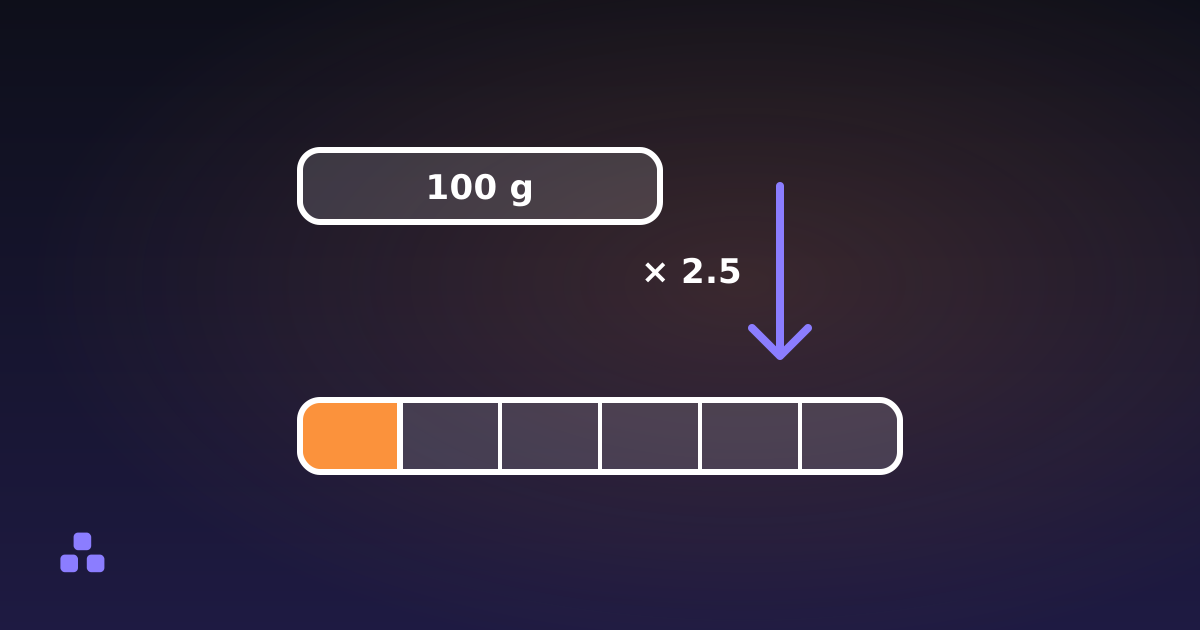
- Packet: 250 g, or 2.5 times the 100 g column, or 8.3 servings: 5,025 kJ, 1,200 kcal.
The numbers hold together: 23 g of fat at 9 kcal, 62 g of carbohydrate at 4 and 6 g of protein at 4 comes to 479 kcal. If the sum of your own conversion is far from that, you are probably using the wrong column. When the serving is a fraction of the packet, such as two thirds of a pizza, the factor to go from serving to packet is the fraction turned over: 1.5. For percentages of a daily reference intake, the percentage calculator handles "what percent of 2,000 is 144" in one step, and how to calculate percentages covers the mental versions.
Where is a correct label still misleading?
In each of these, every number is true and the impression is not.
- The serving is smaller than what people eat. A serving is a manufacturer's or regulator's reference amount, not a recommendation. If you eat three servings, the figures are three times the printed ones.
- As sold against as prepared. Dry pasta, oats and soup powder are labelled as sold, so per 100 g is mostly starch and no water. Cooked, the same food weighs two or three times as much and the per-100 g energy drops accordingly. Some products print both columns; if there is only one, check which.
- Rounding to zero. US rules let calories under 5 per serving be listed as zero, and let fat under 0.5 g per serving be listed as 0 g (21 CFR 101.9(c)). Calories up to and including 50 are rounded to the nearest 5, above 50 to the nearest 10. A product whose serving is a fraction of a gram can show 0 on every line and still be mostly fat by weight.
- Sodium against salt. Some labels give sodium and some give salt. Salt is about 2.5 times the weight of the sodium in it, so 400 mg of sodium is roughly 1 g of salt.
- "Of which sugars". The sugars line is a part of the carbohydrate line, not an addition to it. Adding them double counts.
What can a converter not do for you?
It changes units; it does not know your product. The unit converter converts mass, volume and energy, and has no idea what a serving is, so the multiplication by serving size is yours. It treats a US cup as 236.588 ml, whereas US nutrition labels use a legal cup of 240 ml, so a "1 cup" serving converted by tool will differ from the printed millilitres by about 1.4%. It cannot tell which gallon, ounce or tonne a foreign label meant, and it cannot turn a volume into a weight without knowing the food's density. For anything medical, such as managing diabetes or an allergy, the printed label and a dietitian outrank any arithmetic done here.
Keep the unit converter open next to the packet: put the serving weight in ounces or grams, and kJ or kcal, and read the other system off the table beneath, which saves converting one pair at a time. If you are working across unit systems more generally, metric to imperial: the conversions worth knowing has the exact factors and the traps, including the two kinds of ounce and the two kinds of cup.
Frequently asked questions
How do I convert kilojoules to calories on a food label?
Divide the kilojoules by 4.184 to get kilocalories, the "Calories" of everyday use. For example, 1,590 kJ is about 380 kcal. Going the other way, multiply kcal by 4.184. Labels round both figures, so a conversion can land a few kcal away from the number printed next to it.
Should I use the per 100 g column or the per serving column?
Use per 100 g to compare two products fairly, because it is the same weight for both. Use per serving to work out what you actually eat, but only if your portion matches the stated serving; if you eat twice the serving, double every figure. A serving size is chosen by the manufacturer or by rule, so it differs from product to product.
How do I work out the calories in the whole packet?
Multiply the per-100 g figure by the packet weight in grams divided by 100. A 250 g packet at 480 kcal per 100 g holds 480 x 2.5 = 1,200 kcal. If the label gives servings per container instead, multiply the per-serving figure by that number. Check that the two routes agree before trusting either.
Why does a label say zero calories when the food has some?
In the United States a serving with fewer than 5 calories may be listed as zero, and fat below 0.5 g per serving may be listed as 0 g (21 CFR 101.9). If the serving is very small, the rounding hides everything. Look at the ingredient list: if oil or sugar comes first, the product is not calorie-free.
Is salt the same as sodium on a nutrition label?
No. Salt (sodium chloride) weighs about 2.5 times as much as the sodium in it. A label showing 400 mg of sodium corresponds to roughly 1 g of salt. Check which one a label gives before comparing it with a daily limit, which may be stated in either.
Last updated October 10, 2026